MCP Explained: How AI Connects to the Tools You Already Use
Loading likes…
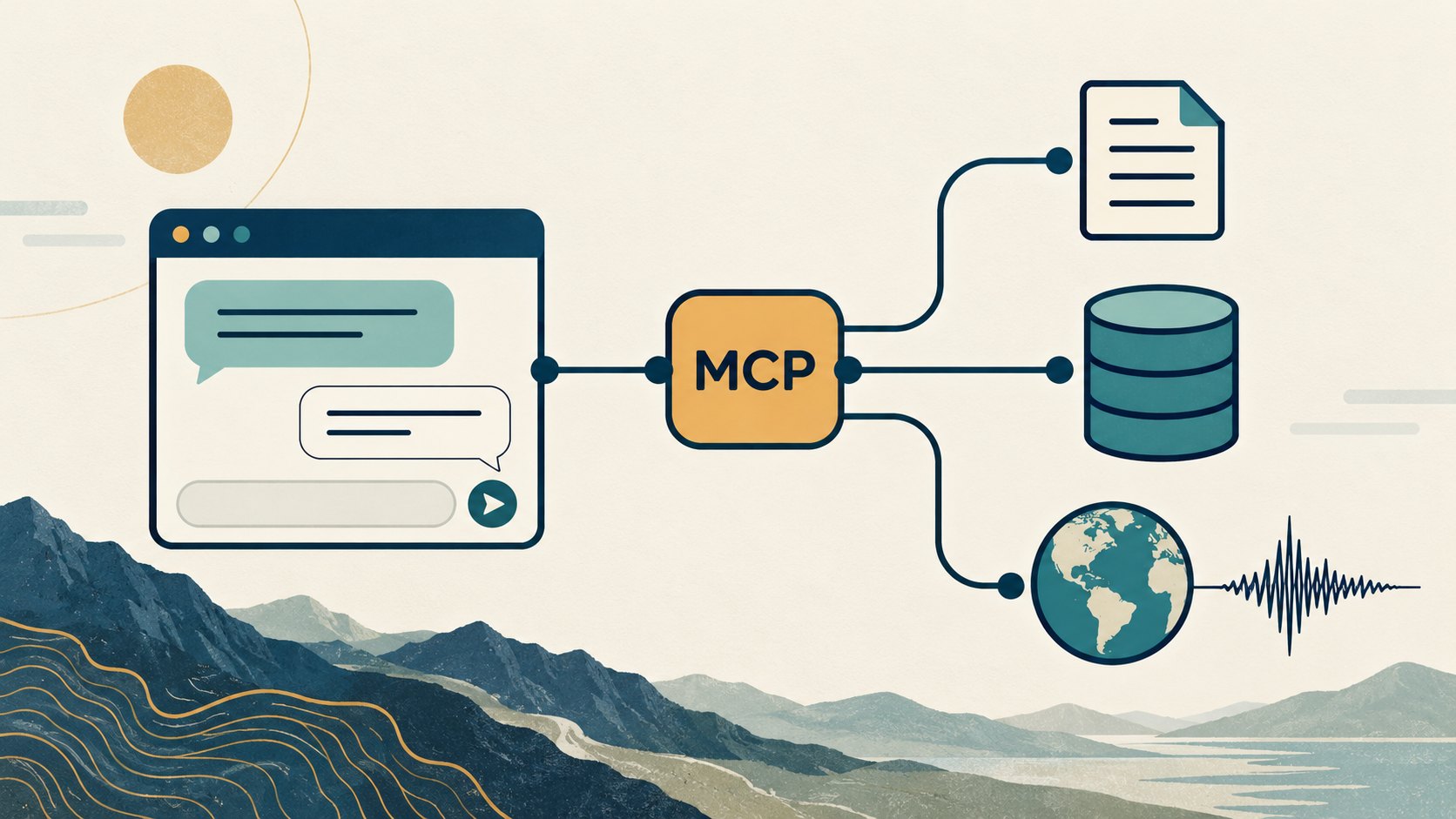
Ask an AI assistant to explain earthquakes, and it can probably give you a useful answer. Now ask it to find earthquakes recorded last month and summarize their locations.
That second request needs something extra: access to an earthquake catalog. The assistant needs a way to ask for records and receive the results.
This is where the Model Context Protocol, usually shortened to MCP, comes in.
The problem MCP helps solve
An AI application might need information from several places: files on your computer, a company database, a calendar, or a scientific data service. Each connection can require its own integration work.
MCP provides a shared standard for those connections. It describes how AI applications can discover available tools and exchange information with them. Developers still have to build and configure the connections, but they can use a common approach instead of designing every connection from scratch. The official introduction compares MCP to a USB-C port for AI applications.
Think about plugging accessories into a laptop. A shared connector makes it easier to use different devices. It does not decide what each device does. In a similar way, MCP standardizes communication while the connected tools do their particular jobs.
Who created it?
Anthropic, the company behind Claude, introduced and open-sourced MCP on November 25, 2024. Although it started at Anthropic, it is an open standard that other AI applications and tool developers can implement.
A simple earthquake example
Imagine we build a read-only connection between an AI assistant and an earthquake catalog. We give it a tool that searches earthquakes by date and magnitude.
You ask:
“Find earthquakes of magnitude 5 or greater worldwide during September 2026.”
Here is what would happen:
-
The assistant identifies the earthquake-search tool and supplies your date range and minimum magnitude.
-
The AI application passes that request to a small piece of software called an MCP server.
-
The server queries the earthquake catalog and returns the matching records.
-
The assistant uses those records to prepare a readable summary with a link to the source.
The earthquake records come from the catalog. The assistant helps you ask for them and understand the result.
This is an illustrative integration, not a claim that USGS provides an official MCP server. The real USGS earthquake catalog service already supports searches using dates, magnitudes, and locations. A developer could build an MCP connection around that service.
What does “server” mean here?
In this context, a server is software that offers capabilities to the AI application. It could run on your own computer or on another machine. It does not necessarily mean buying or maintaining a large cloud server.
The useful distinction is between the application you interact with and the software that connects it to a particular tool or data source. The MCP architecture guide explains how those parts communicate.
Does MCP replace an API?
You may have heard the term API. It means an interface that software uses to communicate with other software.
Our earthquake example can use both: the MCP server communicates with the AI application using MCP, then requests records through the catalog’s existing API. The catalog does not need to be rebuilt just to support this workflow.
What about safety?
Connecting an assistant to outside tools also means deciding what it should be allowed to do.
Searching public earthquake records is different from deleting files or sending an email. For this example, read-only access is enough. There is no reason to give the assistant permission to change the catalog.
MCP alone does not guarantee a secure connection or a correct answer. Developers still need appropriate permissions and safeguards, and readers should be able to check the sources behind a summary. The project publishes security guidance for implementations.
One quick check
In our example, which part supplies the earthquake records: the AI model, MCP, or the catalog?
The catalog. MCP provides a standard way to connect the pieces, and the assistant turns the returned information into something useful.
That is the central idea: a common way for AI applications to work with information and tools beyond the conversation.
Further reading
Found this article useful?
Loading likes…
Disclaimer of liability
The information provided by the Earth Inversion is made available for educational purposes only.
Whilst we endeavor to keep the information up-to-date and correct. Earth Inversion makes no representations or warranties of any kind, express or implied about the completeness, accuracy, reliability, suitability or availability with respect to the website or the information, products, services or related graphics content on the website for any purpose.
UNDER NO CIRCUMSTANCE SHALL WE HAVE ANY LIABILITY TO YOU FOR ANY LOSS OR DAMAGE OF ANY KIND INCURRED AS A RESULT OF THE USE OF THE SITE OR RELIANCE ON ANY INFORMATION PROVIDED ON THE SITE. ANY RELIANCE YOU PLACED ON SUCH MATERIAL IS THEREFORE STRICTLY AT YOUR OWN RISK.
Leave a comment