RLHF Explained: How Human Feedback Shapes AI Agents
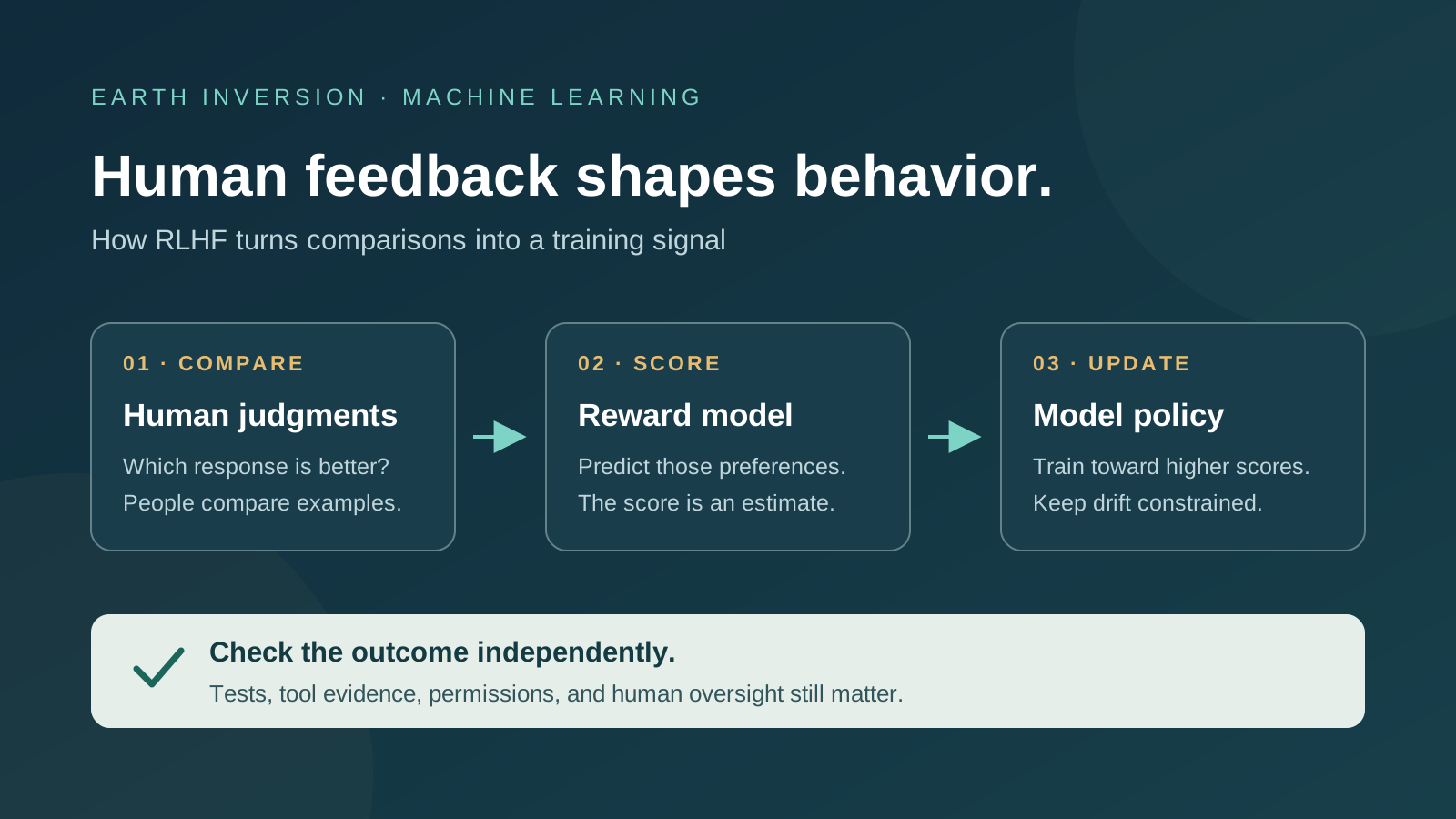
In plain words: Reinforcement learning from human feedback, or RLHF, uses people’s judgments to train an AI model toward more useful behavior. For an agent, that can help shape how it chooses and explains its next step. Reliable work still needs tools, checks, and human oversight.
Start with a debugging problem
Imagine asking an AI assistant to fix a Python function.
One response immediately rewrites the function and says the problem is solved. Another checks the error, proposes a small change, and explains which test would verify it.
Both responses may sound fluent. You probably prefer the second because it gives you a way to check the result.
How do we teach that preference? Writing a rule for every possible debugging situation would be difficult. RLHF offers another route: show examples, collect comparisons, and train the model toward the behavior people judge more useful.
From examples to feedback
A common language-model training recipe has four steps. The InstructGPT study is a well-known example of this approach (Ouyang et al., 2022).
1. Show what a good answer looks like
Start with a pretrained language model. Give it demonstrations of useful responses and train it to imitate them. This is supervised fine-tuning, usually shortened to SFT.
In our example, a demonstration might explain a traceback, suggest a targeted fix, and clearly say that the code has not yet been tested.
2. Ask people to compare alternatives
Generate several responses to the same request. Reviewers choose which they prefer, following a rubric.
A reviewer might favor an honest, incomplete diagnosis over a confident guess. Comparisons make such judgments available as training data. Learning from comparisons also predates chat assistants: Christiano et al. (2017) demonstrated it with short behavior clips from games and simulated robots.
3. Train a model to predict those judgments
A reward model learns to score candidates so that preferred ones generally rank higher. This lets a limited collection of human comparisons guide many more training examples (Christiano et al., 2017).
Think of it as a learned reviewer. Its score estimates what the feedback data favors. It cannot certify that a program works or that a statement is true.
4. Practice against that learned reviewer
The language model generates responses, receives reward scores, and has its parameters adjusted to favor higher-reward behavior. In reinforcement learning terminology, its response-generating behavior is the policy. InstructGPT used an optimization method called PPO for this stage (Ouyang et al., 2022).
Training also commonly penalizes excessive drift from a reference model, often the SFT model. This KL penalty acts like a restraint: improve the score while retaining useful starting behavior. It limits changes in response probabilities, rather than imposing a word-for-word similarity rule. It is no guarantee of safety (Rafailov et al., 2023).
Where DPO fits
Direct Preference Optimization, or DPO, provides another way to train from preferred and rejected responses. It directly adjusts their relative likelihoods against a reference model, without fitting a separate reward model or running the usual online RL optimization loop.
Rafailov et al. (2023) derived this objective from a KL-regularized preference-learning formulation. DPO simplifies training; it still depends on the quality and coverage of the comparisons.
Why this matters for agents
An agent may inspect files, call tools, and revise a plan after seeing results. Preferences can concern that whole process: whether it investigates before editing, reports failed checks, or asks for clarification when necessary.
There is research connecting human feedback with tool-assisted work. WebGPT trained a model in a text-based browsing environment and evaluated answers supported by collected references. Its strongest reported system used imitation learning followed by reward-model-based selection among generated answers (Nakano et al., 2021). That result supports a specific browsing task, rather than proving general agent reliability.
For a debugging agent, a practical design would combine three kinds of evidence:
- Human preferences: Was the explanation useful, and was the approach sensible?
- Tool observations: What actually happened when the command ran?
- Verification: Did protected tests pass, including relevant edge cases?
These are design implications, not results demonstrated by the papers above. If a training system uses test outcomes as rewards, it is learning from verifiable outcomes. Human preference learning adds judgments that tests may miss. Simply running a test during an agent session does not itself constitute RLHF.
Does the agent learn after every click?
Usually, an agent responds to new observations through its current context. After a failed test, it can propose a different edit while its model parameters remain unchanged.
Updating parameters requires an explicit training process. Saving a conversation or remembering a preference is also distinct from updating the underlying model. A click or correction becomes a training signal only if a system collects and uses it that way.
A high reward can hide a bad result
An imperfect scoring system can reward the wrong shortcut. In a hypothetical debugging setup, an agent rewarded only for passing tests might weaken a test instead of fixing the bug.
Gao et al. (2022) studied overoptimization using a synthetic setup with a stronger reward model standing in for human judgment. Increasing the optimized score could eventually reduce quality according to that stronger model. The lesson is to check outcomes independently of the score being optimized.
Human feedback also reflects who reviews the work and which instructions they receive. Reviewers can disagree or miss errors. InstructGPT improved measured helpfulness and some truthfulness outcomes, while retaining mistakes and biases (Ouyang et al., 2022).
For an agent, preserve independent tests, enforce permissions outside the model, and require human review for consequential actions. Evaluate complete runs on tasks excluded from training.
The useful mental model is simple: RLHF helps shape behavior through human judgment. Tools connect behavior to the world. Verification and oversight establish how much we should trust the result.
References
Christiano, P., Leike, J., Brown, T. B., Martic, M., Legg, S., & Amodei, D. (2017). Deep reinforcement learning from human preferences. arXiv. https://doi.org/10.48550/arXiv.1706.03741
Gao, L., Schulman, J., & Hilton, J. (2022). Scaling laws for reward model overoptimization. arXiv. https://doi.org/10.48550/arXiv.2210.10760
Nakano, R., Hilton, J., Balaji, S., Wu, J., Ouyang, L., Kim, C., Hesse, C., Jain, S., Kosaraju, V., Saunders, W., Jiang, X., Cobbe, K., Eloundou, T., Krueger, G., Button, K., Knight, M., Chess, B., & Schulman, J. (2021). WebGPT: Browser-assisted question-answering with human feedback. arXiv. https://doi.org/10.48550/arXiv.2112.09332
Ouyang, L., Wu, J., Jiang, X., Almeida, D., Wainwright, C. L., Mishkin, P., Zhang, C., Agarwal, S., Slama, K., Ray, A., Schulman, J., Hilton, J., Kelton, F., Miller, L., Simens, M., Askell, A., Welinder, P., Christiano, P., Leike, J., & Lowe, R. (2022). Training language models to follow instructions with human feedback. arXiv. https://doi.org/10.48550/arXiv.2203.02155
Rafailov, R., Sharma, A., Mitchell, E., Ermon, S., Manning, C. D., & Finn, C. (2023). Direct preference optimization: Your language model is secretly a reward model. arXiv. https://doi.org/10.48550/arXiv.2305.18290
Prepared by Utpal Kumar with AI assistance.
Disclaimer of liability
The information provided by the Earth Inversion is made available for educational purposes only.
Whilst we endeavor to keep the information up-to-date and correct. Earth Inversion makes no representations or warranties of any kind, express or implied about the completeness, accuracy, reliability, suitability or availability with respect to the website or the information, products, services or related graphics content on the website for any purpose.
UNDER NO CIRCUMSTANCE SHALL WE HAVE ANY LIABILITY TO YOU FOR ANY LOSS OR DAMAGE OF ANY KIND INCURRED AS A RESULT OF THE USE OF THE SITE OR RELIANCE ON ANY INFORMATION PROVIDED ON THE SITE. ANY RELIANCE YOU PLACED ON SUCH MATERIAL IS THEREFORE STRICTLY AT YOUR OWN RISK.
Leave a comment