From Phase Pickers to Seismic Foundation Models
Picture an earthquake-monitoring pipeline where every job runs its own AI model: one to detect an event, one to pick the P arrival, another for the S arrival, another to estimate magnitude, another to read first motion. That is more or less how modern seismic machine learning grew up — a toolbox of narrow specialists, each trained from scratch on its own carefully labeled dataset.
Foundation models propose a different starting point: first learn one reusable representation of waveforms, then adapt it to each task with a much smaller labeled dataset. The interesting question isn’t whether seismic data are literally a language. It’s whether their recurring structure — noise, onsets, phases, amplitudes, frequency content, station quirks — is regular enough that a model can learn useful context before we ever tell it what a given trace means.
The central idea
A phase picker learns to answer one question directly. A waveform foundation model first learns a general-purpose representation of seismic signals, then receives a small task-specific head or fine-tuning step for the question at hand.
From rules to learned features
The through-line of this history is a single question: who decides what matters in a noisy trace? STA/LTA compares the energy in a short window against a long one; template matching asks whether a new trace resembles an event we have already seen. In both, a human hard-codes the signal to look for.
Deep networks handed that choice to the training data instead. Convolutional pickers learned the relevant features from labeled examples; attention-based models could weigh a wider stretch of the trace at once. Neither replaced seismology — they offered a new way to turn decades of waveform archives into predictions.
Why PhaseNet was a breakthrough—and why it is not a foundation model
PhaseNet struck a simple supervised-learning bargain: pair three-component waveforms with analyst-labeled P and S arrivals, then train a network to output P, S, and noise probabilities through time. Wherever a probability curve peaks, you have a pick. Its original evaluation showed just how much learned features could beat hand-designed picking rules [1].
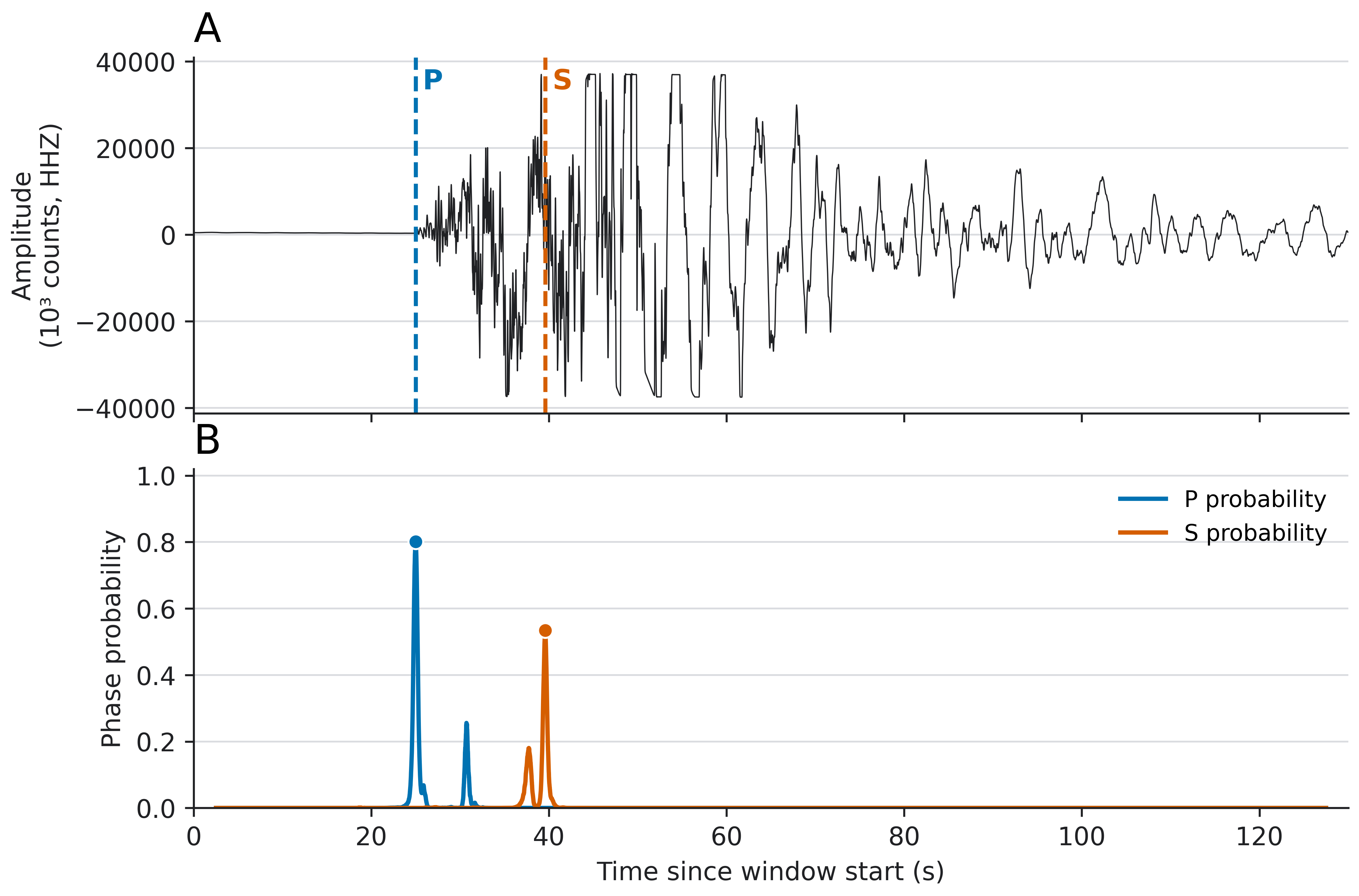
That is exactly why PhaseNet caught on: it turns a slow, subjective judgment into a fast, repeatable mapping from waveform to probabilities. Earthquake Transformer pushed the idea further, learning event detection and P/S picking in one network [2], and SeisBench then packaged datasets, models, and a shared interface so they were finally easy to compare and reuse [3].
Their limitation isn’t that they are “bad at learning.” It’s that the training objective fixes the answer they are allowed to give from day one. A picker is optimized to pick; a magnitude regressor is optimized to estimate magnitude; neither knows how to do the other’s job. Move to a new region, a new sensor type, or a new task, and you are often back to collecting labels and making training decisions from scratch.
| Model | Training signal | Primary output | Reuse across tasks |
|---|---|---|---|
| PhaseNet | Analyst-labeled P/S arrivals | P, S, and noise probabilities | A dedicated picking model |
| Earthquake Transformer | Labeled events and arrivals | Detection plus P/S picks | Shared tasks, still supervised |
| SeisLM | Self-supervised waveform objective | General waveform features | Fine-tune for several downstream tasks |
| U-Trans | Reconstruction of corrupted waveforms | Latent waveform features | Adapt features for several tasks |
What makes a picker such as PhaseNet task-specific?
What does “foundation model” mean here?
Think of it like learning a language before choosing a profession. You pick up general vocabulary and how sentences fit together first; the specialized training — law, medicine, seismology — comes later. Knowing the language is not enough to practice law, but it makes the professional training far quicker.
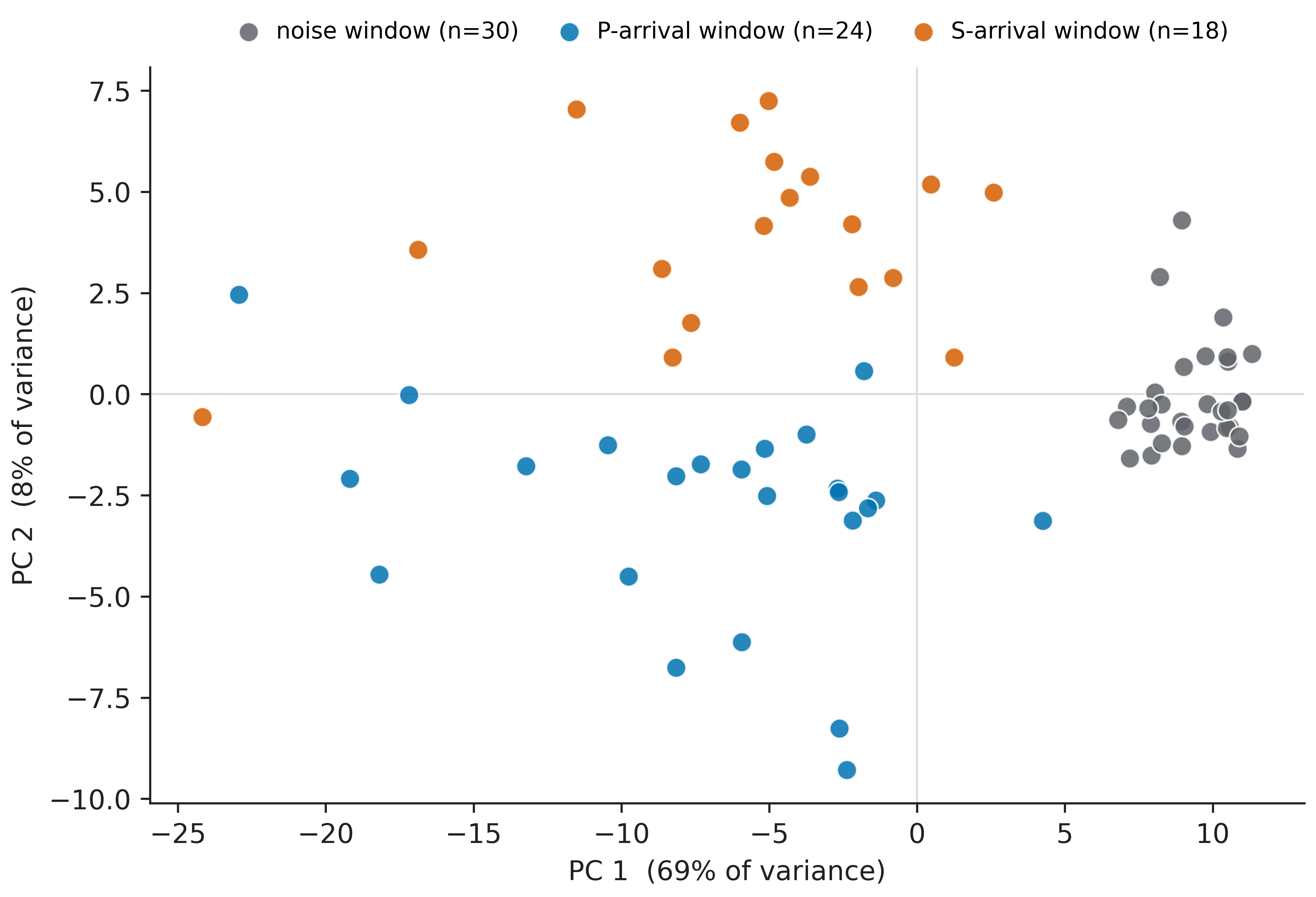
For waveforms, that shared “vocabulary” is an embedding: a compact numerical fingerprint of each trace. Similar waveforms land near each other, so noise and clear arrivals pull apart into different regions of the space. Even an ordinary supervised picker builds such a space inside itself — the figure below projects PhaseNet’s internal embedding of real waveform windows, and noise, P, and S arrivals separate cleanly even though the model was never told which point is which. A foundation model sets out to learn exactly this kind of organized representation from broad, mostly unlabeled data, so it can later be adapted to more than one task [10].
Learning from data that have no labels
Unlabeled does not mean uninformative. Each sample constrains its neighbors, and a physically real signal has to fit smoothly into what surrounds it. Self-supervised learning turns that built-in structure into the training target itself — the data supervises the model, and no analyst has to annotate every trace.
Three recipes dominate. In masked prediction, part of the trace is hidden and the model must infer the missing piece from its surroundings. Contrastive learning pulls two views of the same signal together in the representation space and pushes unrelated ones apart. Reconstruction corrupts a waveform and trains the model to rebuild it. All three chase the same prize: a representation that keeps the signal structure worth reusing later.
Try it yourself: separate the two training stages
Imagine you have a million continuous traces but only a small local catalog with trusted P picks. Which stage uses which data?
Answer: pretraining feeds on the broad unlabeled archive to learn waveform representations. Fine-tuning uses the smaller catalog to teach the model your local definition of a P pick. That second stage is not optional — it is what connects a general representation to a scientifically and operationally meaningful output.
Two recent waveform-model experiments
SeisLM is a self-supervised, encoder-only transformer trained on single-station waveforms [6]. It learns from masked latent features and a contrastive objective, then bolts on small task heads for event detection, phase identification, onset regression, and foreshock/aftershock classification. The takeaway: one representation, learned with no task labels at all, can be put to work on several different questions afterward.
U-Trans takes the reconstruction route instead [7]. Its U-Net/transformer hybrid is pretrained to rebuild waveforms that have been corrupted in both the time and frequency domains; its latent features are then fed — alongside the raw waveform — into heads for phase picking, location, magnitude estimation, and polarity classification. Both models are promising demonstrations that transfer works, not a claim that one frozen model is ready to drop into every network.
Transfer is the practical test
Say a model is pretrained mostly on California earthquakes and then sent to Taiwan, Japan, or an induced-seismicity field. The waveform “grammar” still rhymes, but the distribution shifts underneath it: different geology bends the propagation and reshapes the noise, station responses and orientations differ, sampling rates vary, and the events themselves may be smaller, shallower, or more tightly clustered.
Pretraining can make adaptation far more data-efficient, but it does not make that domain shift vanish. The honest workflow is unglamorous: hold out representative local data, compare against a local baseline, break the errors down by signal-to-noise ratio and distance, and report uncertainty instead of a single headline score. Systematic picker evaluations show plainly that transfer success depends on both the data domain and the task [4].
| Shift to test | Why it matters | Responsible response |
|---|---|---|
| New region or tectonic setting | Propagation and noise patterns change | Fine-tune and evaluate on local held-out data |
| Different instruments | Response, orientation, and bandwidth differ | Check preprocessing and instrument coverage |
| New event population | Magnitude, depth, and rate may shift | Stratify errors; do not trust one aggregate metric |
| Real-time deployment | False positives and uncertainty have consequences | Monitor, calibrate, and retain quality control |
A useful representation is not a calibrated scientific answer. A model can recognize a familiar-looking waveform and still be badly miscalibrated about its own uncertainty, especially outside its training distribution. Earthquake-monitoring decisions still need local evaluation, physically sensible checks, and operational quality control.
What is the soundest response to a new regional deployment?
What could change—and what remains hard
If reusable waveform backbones mature, they could spare us from retraining the same wheel across detection, picking, source characterization, ambient-noise analysis, microseismic and volcano monitoring, and eventually new data types like DAS. Some groups are chasing more speculative routes: SeisMoLLM transplants a pretrained language-model architecture into seismic monitoring [8], while another line tests whether neural audio-compression autoencoders can squeeze and rebuild seismic waveforms well enough to double as a general-purpose representation [9]. These are live research directions, not yet an operational standard.
The hard problems matter just as much: curating geographically diverse data, controlling compute cost, building reproducible benchmarks, enforcing physical consistency, interpretability, honest uncertainty estimation, and fair comparisons against well-tuned specialized models. And scale cuts both ways — a model trained at scale can just as easily spread a bias at scale. The broader foundation-model literature keeps making the same point: whatever a downstream system inherits from its foundation includes the flaws and the strengths [10].
Recap: reusable does not mean universal
Two stages carry the whole idea. Pretraining learns a broad waveform representation from the structure in a large archive. Adaptation then teaches that representation a specific scientific task, with local labels and honest evaluation. PhaseNet remains a landmark supervised picker; SeisLM and U-Trans sketch one path toward a representation that many tasks can share.
The real shift is not from “old AI” to “new AI.” It is moving from rebuilding a narrow model for every task toward asking whether one shared representation can make those specialized models easier to build, adapt, and audit. That promise only pays off with the regional validation and uncertainty work that turns a compelling demo into a tool people can trust.
Where to go next
- Try a supervised baseline with the SeisBench documentation and the related phase-picking tutorial.
- Read the companion overview: Modern Seismic Monitoring Systems.
- For a broader survey of the field, start with the earthquake-seismology review in reference [5].
References
- PhaseNet: A Deep-Neural-Network-Based Seismic Arrival Time Picking Method — Zhu & Beroza (2019), Geophysical Journal International.
- Earthquake Transformer—an attentive deep-learning model for simultaneous earthquake detection and phase picking — Mousavi et al. (2020), Nature Communications.
- SeisBench—A Toolbox for Machine Learning in Seismology — Woollam et al. (2022), Seismological Research Letters.
- Which Picker Fits My Data? A Quantitative Evaluation of Deep Learning Based Seismic Pickers — Münchmeyer et al. (2022), JGR: Solid Earth.
- Machine Learning in Earthquake Seismology — Mousavi & Beroza (2023), Annual Review of Earth and Planetary Sciences.
- SeisLM: a Foundation Model for Seismic Waveforms — Liu et al. (2024), arXiv preprint.
- U-Trans: a foundation model for seismic waveform representation and enhanced downstream earthquake tasks — Saad, Chen & Alkhalifah (2026), Scientific Reports.
- SeisMoLLM: Advancing Seismic Monitoring via Cross-modal Transfer with Pre-trained Large Language Model — Wang et al. (2025), arXiv preprint.
- Testing Audio Compression Autoencoders for Seismology: Moving Toward Foundation Models — Laurenti et al. (2026), JGR: Machine Learning and Computation.
- On the Opportunities and Risks of Foundation Models — Bommasani et al. (2021), arXiv preprint.
Disclaimer of liability
The information provided by the Earth Inversion is made available for educational purposes only.
Whilst we endeavor to keep the information up-to-date and correct. Earth Inversion makes no representations or warranties of any kind, express or implied about the completeness, accuracy, reliability, suitability or availability with respect to the website or the information, products, services or related graphics content on the website for any purpose.
UNDER NO CIRCUMSTANCE SHALL WE HAVE ANY LIABILITY TO YOU FOR ANY LOSS OR DAMAGE OF ANY KIND INCURRED AS A RESULT OF THE USE OF THE SITE OR RELIANCE ON ANY INFORMATION PROVIDED ON THE SITE. ANY RELIANCE YOU PLACED ON SUCH MATERIAL IS THEREFORE STRICTLY AT YOUR OWN RISK.
Leave a comment