SeismoAlert: A real-time earthquake monitoring toolkit in Python (codes included)
I built SeismoAlert to fetch USGS earthquake data, run statistical analysis, detect anomalies, and generate interactive maps from a single CLI.
Introduction
In this project, I built SeismoAlert, a Python toolkit for real-time earthquake monitoring and anomaly detection using USGS earthquake data.
I designed it as a practical command-line workflow so I can quickly fetch new events, analyze seismicity trends, generate interactive maps, and run alert checks from the same interface.
Project repository: SeismoAlert on GitHub
Motivation
I wanted a compact and reproducible workflow for day-to-day earthquake monitoring tasks.
In many practical cases, we need to answer questions like:
- What happened in the last 24 hours above a certain magnitude?
- Is the current seismicity rate unusual compared to the recent baseline?
- Where are the events concentrated spatially?
- Did any alert-level condition trigger?
Instead of combining multiple scripts and manual checks, I built one package with a clear CLI and testable modules.
What this app does
SeismoAlert includes four primary workflows:
fetch: download recent events from USGSanalyze: run Gutenberg-Richter analysis and anomaly detectionmap: generate an interactive HTML mapmonitor: run one-shot monitoring with alert rules
I also structured it so I can use the same functionality directly as a Python library.
Installation
Install from PyPI
pip install seismoalert
Install from source
git clone https://github.com/earthinversion/seismoalert.git
cd seismoalert
pip install -e .
Install for development
pip install -e ".[dev,test,docs]"
How I use it
1) Fetch recent earthquakes
# Default: last 1 day, M>=2.5
seismoalert fetch

# Custom window and threshold
seismoalert fetch --days 7 --min-magnitude 4.0 --limit 200
2) Run seismicity analysis
seismoalert analyze --days 30 --min-magnitude 1.0 --window-days 7
This step computes:
- magnitude of completeness (Mc)
- Gutenberg-Richter
aandbvalues - anomalous windows in event rate
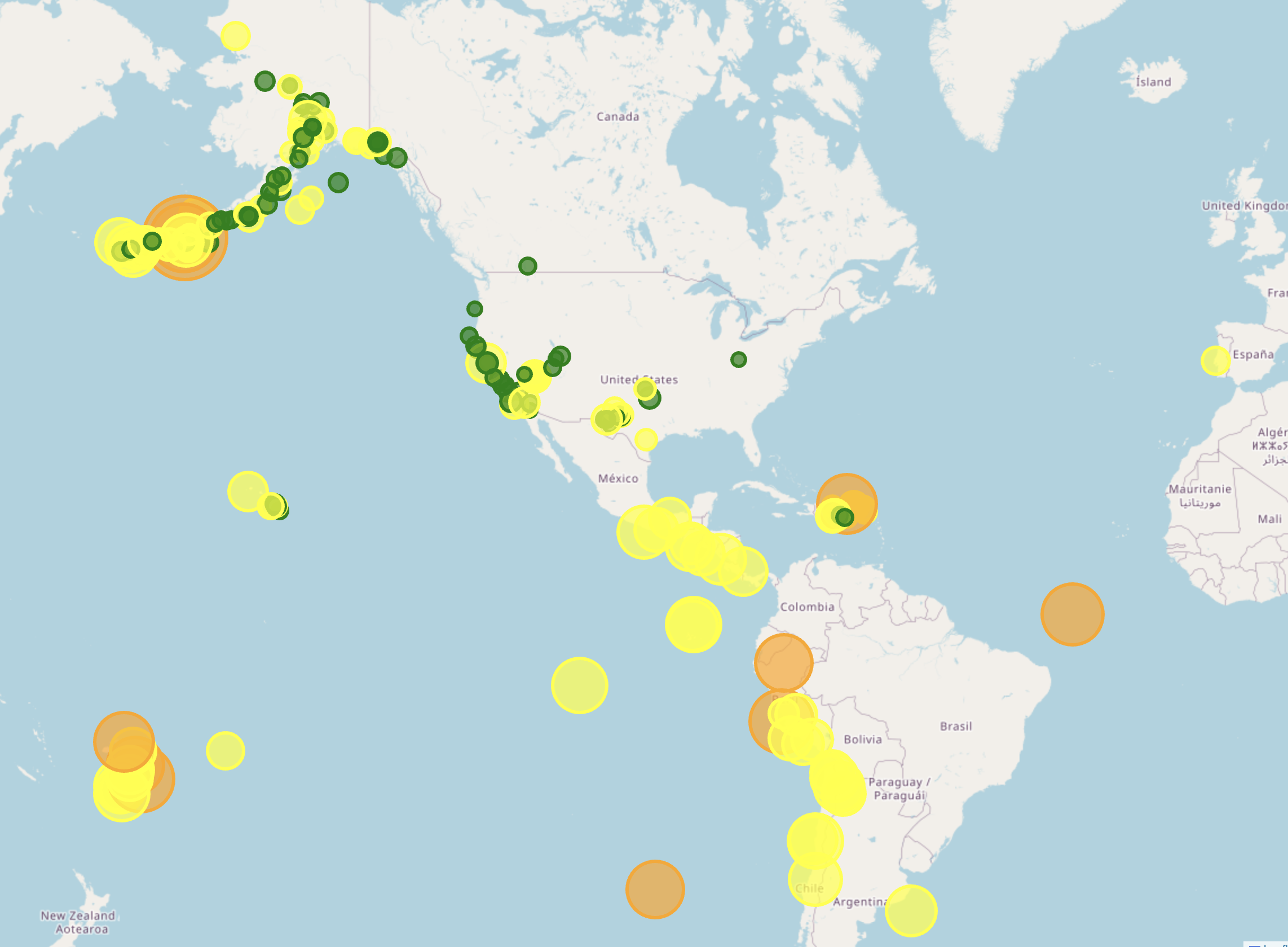
3) Generate an interactive map
seismoalert map --days 7 --min-magnitude 2.5 --output earthquakes.html
4) Run monitor and alert checks
seismoalert monitor --days 1 --min-magnitude 4.0 --alert-magnitude 6.0 --alert-count 50
Current alert rules include:
- large earthquake threshold
- high seismicity-rate threshold
Background loop with Makefile
I also use the project Makefile when I want a simple operational loop.
I run these commands from the SeismoAlert repository root:
make install
make run
make status
make close
In this mode, make run launches a background monitor loop and writes logs to .run/seismoalert.log.
For ad hoc commands, I can use:
make fetch ARGS="--days 2 --min-magnitude 3.0"
make analyze ARGS="--days 30 --window-days 7"
make map ARGS="--output earthquakes.html"
make monitor ARGS="--alert-magnitude 6.5"
If I am not inside the repository (or if I installed only from PyPI), I run the CLI directly instead of make:
seismoalert fetch --days 2 --min-magnitude 3.0
seismoalert analyze --days 30 --window-days 7
>> seismoalert fetch --days 2 --min-magnitude 3.0

Fetched 74 earthquakes (M>=3.0, last 2 day(s))
Saved 74 events to /Users/utpalkumar/Documents/datascience/seismoalert-CI-CD-Github/earthquakes.csv
Largest event: M7.1

Top events:
  M7.1  55 km NNW of Kota Belud, Malaysia  (2026-02-22 16:57 UTC)
  M6.1  93 km SW of Nikolski, Alaska  (2026-02-23 05:11 UTC)
  M6.0  south of the Fiji Islands  (2026-02-22 07:43 UTC)
  M5.8  Kuril Islands  (2026-02-22 07:25 UTC)
  M5.5  92 km SW of Nikolski, Alaska  (2026-02-23 10:02 UTC)
Using SeismoAlert as a Python library
I can also integrate SeismoAlert inside Python workflows:
from seismoalert.client import USGSClient
from seismoalert.analyzer import gutenberg_richter

client = USGSClient()
catalog = client.fetch_earthquakes(min_magnitude=2.5)
gr = gutenberg_richter(catalog)
print(gr.b_value)
Engineering workflow and quality controls
I built this project with maintainability in mind:
- package layout under
src/seismoalert - unit, integration, and e2e tests
- linting and formatting workflow
- documentation built with Sphinx
- CI checks and coverage reporting
Useful project links:
- Docs: seismoalert.readthedocs.io
- Issues: GitHub Issues
How I plan to evolve this app
I see this as a strong base that can evolve in several directions:
- add region-specific presets and tectonic-zone filters
- support richer alert delivery backends (webhook/email integrations beyond stubs)
- add configurable anomaly strategies for different seismic regimes
- publish scheduled summaries and trend snapshots
- add more visualization layers beyond epicenter points
I also plan to keep improving reliability by expanding test coverage around edge cases and API failure handling.
Download and source code
I shared the source-code download in the downloads section: SeismoAlert Download Entry
Source code repository: GitHub - earthinversion/seismoalert
Disclaimer of liability
The information provided by the Earth Inversion is made available for educational purposes only.
Whilst we endeavor to keep the information up-to-date and correct. Earth Inversion makes no representations or warranties of any kind, express or implied about the completeness, accuracy, reliability, suitability or availability with respect to the website or the information, products, services or related graphics content on the website for any purpose.
UNDER NO CIRCUMSTANCE SHALL WE HAVE ANY LIABILITY TO YOU FOR ANY LOSS OR DAMAGE OF ANY KIND INCURRED AS A RESULT OF THE USE OF THE SITE OR RELIANCE ON ANY INFORMATION PROVIDED ON THE SITE. ANY RELIANCE YOU PLACED ON SUCH MATERIAL IS THEREFORE STRICTLY AT YOUR OWN RISK.